

Where Entry and Exit Converge
Where Entry and Exit Converge: The Shared Ritual of Holy Dying at Mount Saint Joseph Convent, 1847–1910
-David McAllister, Archivist
Mount Saint Joseph was more than the center of congregational life—it was also the place where generations of Sisters of Saint Joseph prepared for death and were laid to rest. Drawing on diaries, annals, and obituary notices, this article examines the shared rituals that accompanied sisters from their final illness through burial between 1847 and 1910.
In the quiet chill of December 1890, nineteen-year-old Kathleen O’Meara lay dying at Mount Saint Joseph Convent. An immigrant from County Tipperary, Ireland, she had entered the Sisters of Saint Joseph only two years earlier and had recently been “sent home” to Mount Saint Joseph from her teaching assignment at Nativity B.V.M. School. On December 1, as her health failed, Father Martin Geraghty, O.S.A., received her religious vows at her bedside. Seven weeks later, on the Feast of the Holy Name, Sister Maria Concepta O’Meara died.
To modern readers, the death of a nineteen-year-old sister seems a tragic interruption of a life scarcely begun. Yet Maria Concepta’s experience was not unusual within the nineteenth-century community. She was one of more than 210 Sisters of Saint Joseph who died before reaching the age of forty during the Congregation’s first decades. Many never lived long enough to complete even a decade of religious life.
Mount Saint Joseph Convent stood at the center of this cycle of life and death. It was the place where women entered the congregation, received their formation, and prepared for ministry. It was also the place where sisters returned when illness ended their active work. Sent home from schools, orphanages and parish convents, they came back to the Motherhouse to receive the sacraments, spend their final days among their sisters, and be buried from the convent chapel.
The annals, diaries, and obituary notices preserved from this period reveal a community in which death was woven into the ordinary rhythms of religious life. At Mount Saint Joseph, the Motherhouse was not simply the place where religious life began. For most sisters, it was also where it reached its completion.
Sent Home
When illness ended a sister’s active work, she did not leave community life; she was drawn back to its center. From parish schools, academies and asylums, sisters were “sent home” to Mount Saint Joseph when teaching or kitchen work could no longer be sustained. Some returned after long decline; others were brought home in haste, already in the final stages of consumption or acute illness.
The direction of movement, however, was constant: from mission back to Mount Saint Joseph. Sister Adelaide Reilly came home from St. Michael School late in 1903. She ”has been sick with jaundice for several months and is not improving.” She died of liver cancer in early 1904. When Sister Regina McCarthy fell ill, the Motherhouse received “a telegram that Sr. Regina is to be home in 4 o’clock train to die.” Mother Mary John Kieran, who received the telegram, ”thought she would have died in the entry after coming down the Hill.” Instead of passing away on the threshold, she was received into the Convent, where she died shortly after receiving the sacraments.
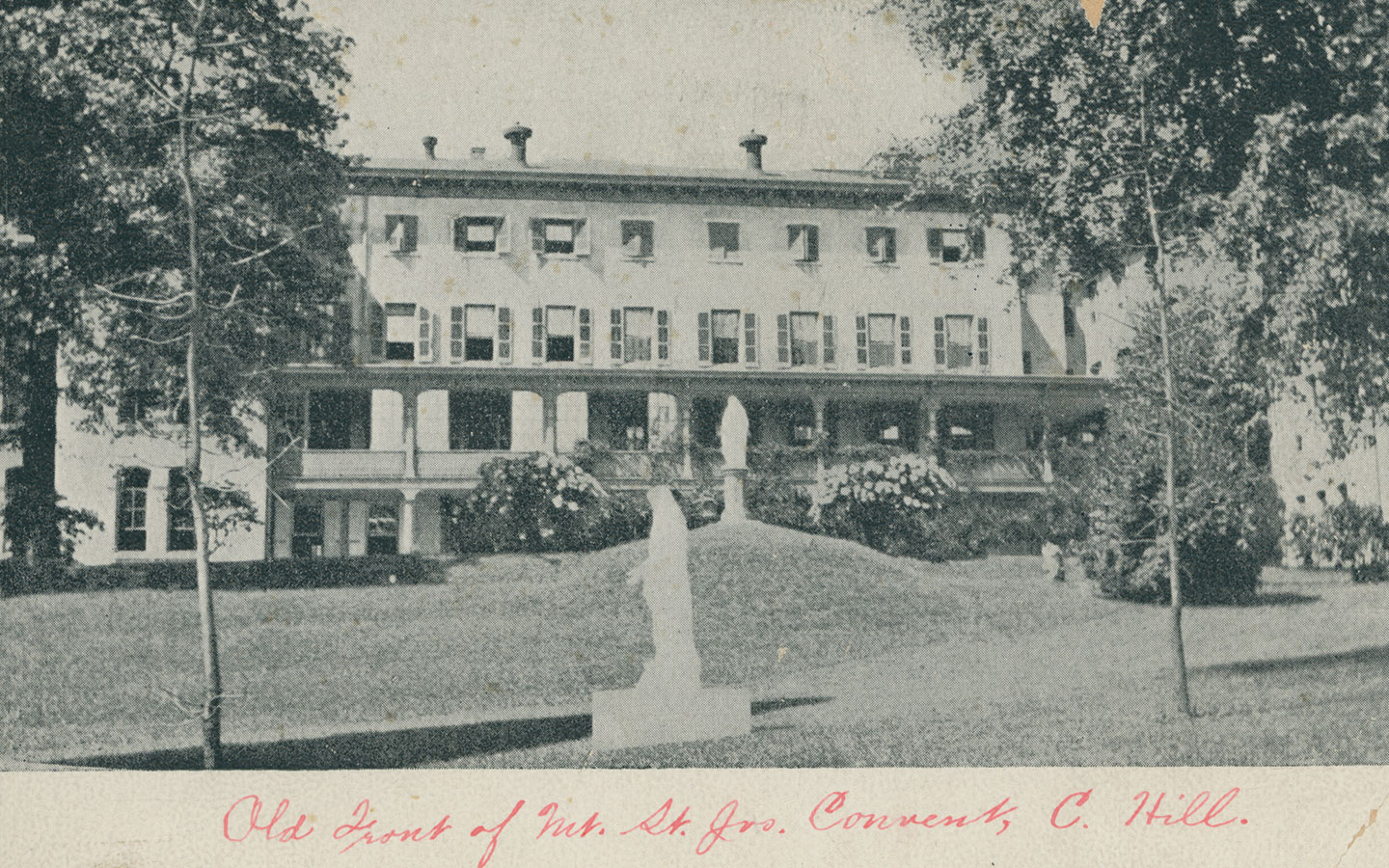 Postcard view of Mount Saint Joseph Convent, c. 1895.
As entries make clear, these deaths occurred in the middle of a building busy with academy students, postulants, novices, and sick sisters; it was clear, in other words, that death at the Convent was as constant as celebrating St. Joseph’s Day or the crowning of Mary in May. “Sister Catherine died of small pox. Snowing all day,” a diary recorded in 1881. “Sr. Oswald received communion, fell into her agony a 9 o’clock. Died at 3:10 pm. 1st lesson in Latin.” The inclusion of the weather or a Latin lesson did not diminish the death of a sister. Rather, it normalized such deaths and revealed that these passings were understood as part of the ordinary cycle of convent life.
 Diary Entry, Mother Mary John Kieran, October 2, 1883.
Except for a few extraordinary instances, both the funerals and burials occurred at Mount Saint Joseph Convent. At times, sisters died while on mission. When Mother Salome died, “Sisters Clement and Stanislaus brought the body [home].” Likewise, when Sister John Francis died, “her body came here at five o’clock and four sisters came with it.” Just like with sisters who died at Mount Saint Joseph, these sisters received a funeral in chapel and were buried in the congregation’s cemetery on the same grounds. There was even a vault near the chapel to store a body if inclement weather prevented immediate burial.
A Good Death
Underlying this sequence was a devotional tradition older than the congregation itself. Saint Joseph, the namesake patron of the Sisters of Saint Joseph, was venerated in Catholic tradition as the patron of a happy death—happy in the sense of holy. It was death attended by grace, sacrament, and the presence of loved ones. Joseph’s own death, as tradition held it, was the model: he died in the arms of Mary and Jesus, accompanied, consoled, and blessed. A stained-glass window installed in the Convent chapel around 1890—the very years these records describe—depicts this scene. Angels bear a scroll inscribed Beati mortui qui in Domino moriuntur (blessed are the dead, who died in the Lord). For the Sisters of Saint Joseph, replicating the conditions of Joseph’s death was not sentiment. It was vocation. When sisters gathered at a dying sister’s bedside, took turns through the night, and remained “around the bed praying,” they were enacting, as best they could, the same holy company that had surrounded Joseph at his last hour.
 Depiction of the Death of St. Joseph, Stained Glass, Mount Saint Joseph Chapel, Philadelphia, PA. (Photograph by the author)
The return to Mount Saint Joseph was followed, in most cases, by a recognizable sequence.
Sisters received the sacraments at the first indication of serious decline. Confession was heard in the infirmary or at the bedside. Holy Communion was administered, often more than once as illness progressed. The Anointing of the Sick followed when death was judged near. Priests came from Our Mother of Consolation Church. The community gathered as the condition worsened. The goal was not merely to attend the dying sister but to ensure that death occurred within the full sacramental and communal life of the congregation.
The deaths of two sisters in January 1901 exemplify this pattern. Both returned to Mount Saint Joseph Convent sick in early January. Sister Giannette arrived from Holy Infancy School, in Bethlehem, PA. Still a Junior, she “made her [final] vows on her deathbed in the hands of Rev. D. J. O’Sullivan, OSA, January 26th.” She “died 1:25 pm” on the same day. The next day, “at 8:20 am,” Sister Mary Eleanor died. She had come home from Saint Charles School and was “prepared for death” on January 20th.
 Annals from the Motherhouse Community, January 26, 1901.
In other cases, the sequence was compressed or extended. “Received Holy Communion after Mass, and died about ten o’clock this morning.” “Anointed and not able to speak.” “Died shortly after receiving the Blessed Sacrament.” When illness was prolonged, the pattern repeated over days or weeks. Communion in the morning. Prayer at intervals. Visits from superiors and sisters. The rosary at the bedside. The Stations of the Cross when strength permitted.
Mother Saint John Fournier’s death in 1875 was recorded in fuller detail. She received Holy Communion in consciousness. She made her thanksgiving. Priests and superiors came and remained through the night. At the hour of death, absolution was given as she breathed her last. The community was gathered around the bed. The presence of the sisters was consistently noted. One remained “at the side of the bed.” Others “came to relieve” those keeping watch. The infirmary became a shared space of vigil. At times the record noted only that sisters were “around the bed praying.”
Death itself was often marked by time. “At 7:20 a.m.” “About ten o’clock.” “At 3:10 p.m.” The moment was recorded with precision, as though the passage from life required no interpretation beyond its hour. In a community where every hour of the day was strictly budgeted for prayer, teaching, labor, and community life, a sister’s passing was noted with the same meticulous accuracy as any other major convent duty.
 Postcard of Mount Saint Joseph Convent Chapel, c. 1915
After death, the rhythm continued. The body was prepared. Sisters remained with it. The chapel received the remains. The funeral Mass was celebrated in the convent chapel, and burial followed in the adjoining cemetery. Then, Mass was offered for the departed at their Month’s Mind and again at the year anniversary. While the records often mentioned the passing of a sister in a matter-of-fact language, the rituals and celebrations imported meaning and significance to a sisters’ life and death.
Suffering
If the ritual of dying shaped a sister’s final days, prolonged illness shaped the months and years that often preceded them. In many cases death did not arrive at once. It unfolded.
Tuberculosis claimed more sisters than any other disease in the nineteenth and early twentieth centuries, and its course was often long and debilitating. It was noted in the records as “consumption,” “decline,” or simply “TB.” It affected Sisters in their twenties and thirties, with the average age of death being 30. Once infected, symptoms recurred over and over, with prolonged illness often measured in months, sometimes years. Moreover, it was highly contagious and spread easily across missions and convent houses. In McSherrystown alone, sixteen of twenty-five recorded deaths—two-thirds—were attributed to tuberculosis.
Sister Othelia died in her nineteenth year, in the second year of religious life, “of consumption, which she bore with patience and resignation to the Will of God.” Sister Mary Veronica died in her twenty-first year, also of consumption, “with great patience and resignation.” Sister Mary Aurelia, professed only weeks, died of the same disease, “bearing it with great patience and conformity to the divine Will.” Sister Estelle, older than these sisters, “was brought home from St. Charles; she has had consumption for many years but remained in school notwithstanding her miserable health.” She died within three months.
Where illness was prolonged, sisters were praised and remembered for their suffering. Sisters were “bed-ridden for years.” They were “long suffering.” They were “patient sufferers.” They bore “their illness bravely.” They suffered “very patiently, like a good Sister of Saint Joseph.” The phrasing repeated with little variation. Sister Valeria Callahan had cancer and “blood poison,” and her sufferings were described as intense. She remained, nevertheless, “patient in her suffering.” Sister Juliana O’Brien was noted as having suffered “more than any Sister ever suffered in this house,” yet died “after several months with patience and resignation.”
Even sudden deaths were sometimes placed against this background of expected decline. Pneumonia, apoplexy, heart failure, emergency surgeries, and stroke appeared alongside consumption as common causes of death. In the first decade of the twentieth century, the average age at death was only fifty years old. Regardless of the suddenness, the language used to describe the death remained constant. Sisters were “obedient to the end.” They were “humble and charitable in suffering.” They “conformed to the holy will of God.” They “offered their sufferings.”
The diarists and annalists in the 19th century found sisters who continued active ministry even when seriously ill especially virtuous and meritorious. Sister Philomena Maher, for instance, was praised in an obituary inscribed on her record of final vows: “she was a faithful, humble religious.” Moreover, she “labored up to three days teaching her little children, with death pictured on her countenance,” before succumbing. Likewise, Sister Crescentia Heffernan’s service was singled out: “Died Sept. 23rd 1889, 2:45 pm at St. Michael’s—a martyr to her duty.” If patient suffering was the expected norm, patient suffering while still teaching or cooking was the ideal.
 Studio Portrait of Sister Philomena Maher in the Lay Habit, c. 1870.
In this context, extended illness was a temporal structure. It produced long, bedridden periods of nursing and medication, the repeated sacramental visits, the long vigil of sisters moving in and out of the infirmary. It created the conditions under which patience, resignation, and obedience were repeatedly recorded. It was, in other words, an important stage in a sister’s religious life on the path to their ultimate reward of heaven.
Death did not interrupt this path. It completed it.
Conclusion
Across the records of Mount Saint Joseph Convent between 1847 and 1910, movement, illness, and death followed a consistent pattern.
What the records of Mount Saint Joseph reveal is not simply a pattern of return and burial, but a theology of place. The Motherhouse was not incidental to how sisters died; it was constitutive of it. Entry and exit required the same ground, the same chapel, the same community. A sister’s death was not hers alone; it belonged to the congregation, completed in its presence, interpreted through its language, and absorbed into its ongoing life.
Tuberculosis, pneumonia, heart disease, and cancer appear throughout the registers, but the pattern of return remained constant. Sisters died young and old, after brief illness or long suffering, but nearly all passed through the same sequence of return, sacrament, vigil, and burial at Mount Saint Joseph.
The Convent thus appeared in the records not only as a house of formation and governance, not just a school and dormitory for young women, but as the fixed point of completion within the life of the congregation. It was where women entered religious life and where, for most sisters, that life came to its earthly end.